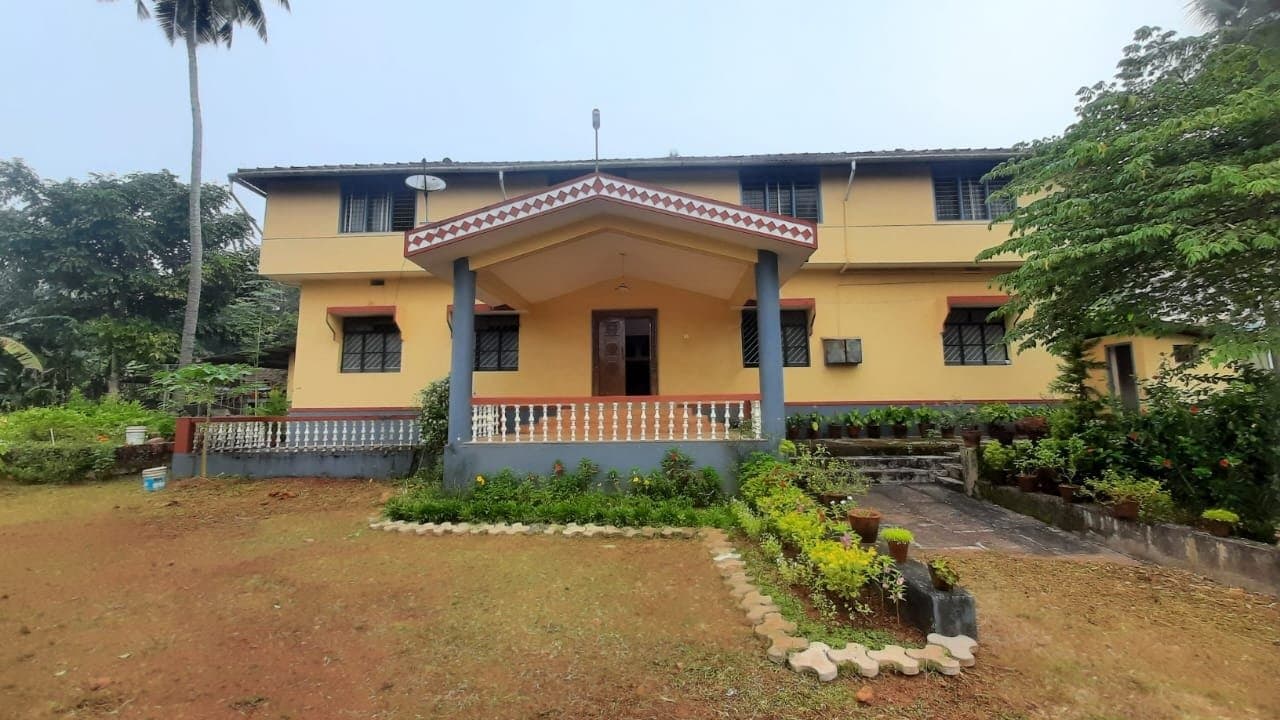
Diocese: Mangalore
Pioneers: Sisters Carmine B Rasquinha, Esperance Rego, Juliana Saldanha and Rose Marie D’Souza
Fajir is situated twenty-two kilometres south-east of Mangalore on Konaje-Thokkottu Road. The lush green valley consists of fertile soil. Nonetheless its distance from the city of Mangalore keeps it rather underdeveloped in all ways to date. As if to add to the woes of underdevelopment, the Catholic populace of Fajir has had to pass through critical phases. Fajir was a part of Ullal-Panir parish. A church was built at Fajir in about 1838 during Padroado – Propaganda controversy. In 1841 the parishioners revolted against the jurisdiction of Verapoly (Propaganda) and erected a pandal at Fajir for religious services. In 1867 Fajir was declared an independent parish under the Patriarch of Goa. The church of Our Lady of Mercy at Fajir was built in 1867 though the construction was completed only in 1882. In 1886 the parish was brought under the jurisdiction of the newly constituted Mangalore Diocese under the Propaganda. In 1909, a portion of the church building was renewed by Fr Joseph Menezes. From then onwards, life for the parishioners continued rather smoothly. However, the impact of having been subjected to various ecclesiastical jurisdictions such as Ullal- Panir, Verapoly, Goa, and finally Mangalore lingered in their memories. It also impacted their life of faith.
The Catholic populace of Fajir, a loyal band of believers, had to be sustained not merely in their faith, but also in their socio-economic empowerment. Fr Salvadore Rodrigues, parish priest, invited the Catechist Sisters of St Ursula to collaborate with him in the task. On their part, the Sisters themselves had been sailing through deep currents. They had been in a nascent stage even after fifty years of their existence. However, they were enterprising.
At their arrival in Fajir on June 4, 1938 they received a thatched house for their residence; they named it Mother of Mercy Convent. They also received a plot measuring four acres in the location of present convent campus. The Sisters commenced their mission instantly. The exhortation of Bishop Victor Fernandes of Mangalore Diocese to them to draw strength and courage from the Holy Spirit in their pioneering work, served as a guiding principle in their mission. They assisted the parish priest in all pastoral activities of the parish. Besides, they attended to the ailing people of Fajir and its vicinity. For this purpose, they opened a dispensary in the Convent with the assistance of Sr Victoria, a Charity Sister from America. Their venture of operating a dispensary at a time when such an apostolate was not part of their mission unfolds the fact that they had not only ‘drawn strength and courage from the Holy Spirit in their pioneering work’ but that they had also taken up challenging ministries. Nothing but a profound love for Christ expressed through their needy neighbour could have been the underlying factor of their heroic endeavour. Visiting families and instilling in them faith and hope was a daily activity of the Sisters. They carried this out regularly in spite of the fact that it was next to impossible to reach several villages due to lack of easy accessibility. How challenging the situation was could be gauged from the fact that they had to cross the river Netravati by a ferry in order to reach Mangalore. All of it reveals that they had driven themselves to the farthest and toughest extent possible in carrying out their mission.
Teaching in the parish school was an important assignment of their mission at Fajir. In this regard, they displayed immense fortitude with their limited expertise, scanty resources, but abundant goodwill. They administered not just one school but two schools. They were: St Joseph Higher Primary School established in 1904 by Fr Joseph Menezes and St Mary Primary School. The latter had come into being as a result of the bifurcation from the St Joseph School and in view of making available quality education to girl children alone. Administering two schools called for more members in the community and therefore more space. Hence a convent building was put up in 1939. Assistance from Propaganda Fide, Miss Smith a benefactor from America, and people of goodwill from India proved timely and valuable in this regard. The new house was a happy change from the thatched residence. A chapel was added to the house on January 30, 1957; Fr Pacificus Menezes OFM Cap, foster parent of the Congregation blessed it during a Eucharistic celebration. Gradually the Sisters undertook also to improve their property: a compound wall was built with the help of Fr Robert Z M D’Souza, an open well was sunk and coconut palms were planted. It was possible to irrigate their land only in 1973 with the advent of electricity supply to the area.
Expectedly pastoral apostolate has been an integral part of their life at Fajir. Preparing children for reception of the sacraments, catechizing children on Sundays, training them for the annual catechism day, accompanying them to Jeevan Jyothi camps, animating sodalities, attending SCC meetings of all eleven wards of the parish, rendering service during CRI camps in parishes that had no presence of religious Sisters, and contributing time and energy to the maximum during festal celebrations of the parish are various activities the Sisters carry out at Fajir. At the post-centenary golden jubilee celebration of the parish church on January 6, 1991, the Sisters put in a great deal of work.
Mudipu was a substation of Fajir parish from January 1, 1991 to 1999. As a pilgrimage centre in honour of Blessed Joseph Vaz, Mudipu was a dynamic location. The Sisters considered themselves privileged to render liturgical, spiritual, and moral service for the duration of eight years to 867 Catholics living in 185 families at Mudipu. They continue to extend their services at Mudipu as and when the need arises. They rendered their services at Infant Jesus Chapel, Pavoor Uliya from 1992 to 1998. The Sisters have put in significant amount of toil in all these places, particularly at their erection as independent parishes.
Mother of Mercy Convent has been a safe haven to everyone due to its lush green surroundings on the one hand and on the other its hospitality. Several Sisters have been choosing this Convent to spend their study period in preparation for their academic exams. Reference to the hospitality of the Convent brings to the scene Sr Josephine Pinto. Her unassuming life filled with warmth is indeed a factor to ponder on; she attended to their needs without drawing attention to herself. She was taken to Shanthi Dham, Provincialate on March 29, 2005 after having spent thirty years at Fajir. We may note that she was the only Sister of the Ursuline Franciscan Congregation who completed 100 years; she passed away on September 29, 2007 after celebrating her birth centenary on June 30, 2007.
There have been disasters as well as joyful celebrations at Mother of Mercy Convent. Two tragedies must be particularly noted: first refers to a blaze that reduced the cowshed of the Convent to ashes on May 13, 1988. People of the locality saved the Convent from the engulfing flames. The second refers to an untimely death of Sr Elize D’Souza on July 26, 1993. The community members as well as the Congregation have withstood these blows eventually. There have been joyful events as well. Sisters Benilda Roche and Benny Fernandes celebrated the silver jubilee of their religious profession on May 10, 1993 and May 8, 1997 respectively.
The convent building had become hardly habitable by the turn of the century. On June 12, 1999 a new, spacious, and well- furnished building was erected and inaugurated; it lay ten metres away from the old building. Sr Noella Menezes, animator, supervised the construction. In 1980s, a demand for education in English medium had begun to sweep through even the rural areas. At Fajir parish, this fact caused a decline of number in the school, which finally led to the amalgamation of its two schools. Gradually, teaching posts have been reduced as well; currently one single Sister in contrast to six in the initial years teaches in the school. This development led to exploring alternative means of income to the Convent. Hence in 2005 a Play School was started. For this purpose the central open square of the Convent was modified into a classroom. Sr Olivia Sequeira headed the school for seven years. Currently, Sr Juliana Jyothi D’Cunha heads it. Fajir continues to be a mission zone and missionary zeal of the Sisters persists.
