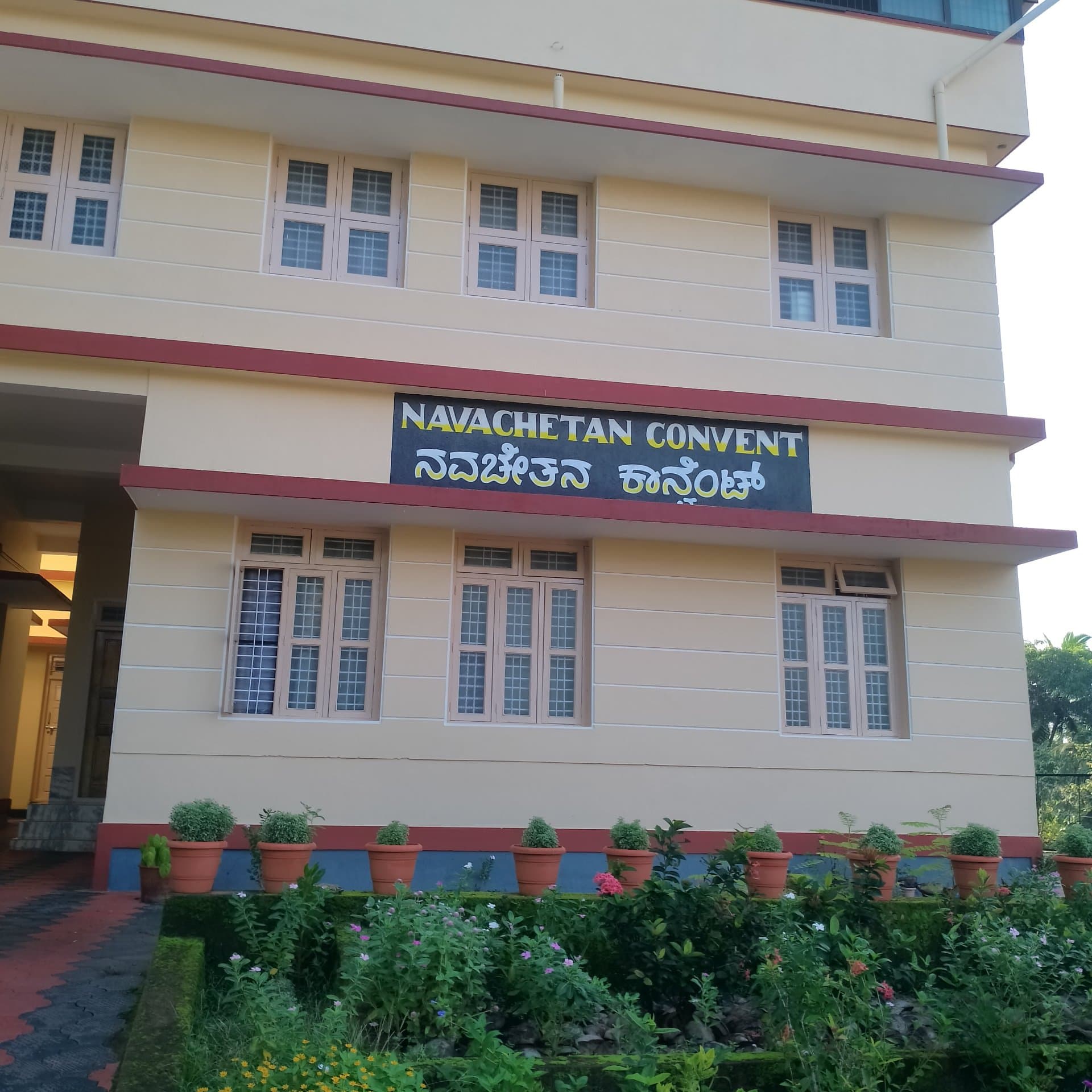
Diocese: Mangalore
Pioneers: Sisters Lenita D’Souza, Angeline Sequeira, Shanthi Lobo and Mariola Picardo
Navachetan Convent at Venur is a recent addition to the annals of the Ursuline Franciscan Congregation. However, its existence in various forms and states, particularly as regards its unique apostolic enterprises, goes back to 1975. Two such ventures are to be highlighted and traced in detail in sketching the history of Navachetan Convent. The first refers to the establishment of ‘Grihini’ and the second denotes the institution of Navachetan School. As both projects have been aiming at the service of the marginalized, namely, women and differently abled children, they must be regarded as unique.
The Centre ‘Grihini’ meaning ‘homemaker’ came into existence in 1975 in the present Navachetan campus. The parish and parishioners offered a four-acre land to the Sisters on condition that they could own it with its cultivation and use it solely for the purpose of the Centre. As the plot had been put under the patronage of Christu Raj Ashram at Venur, it’s Sisters, while commuting to the location lying half a kilometre away from the Convent, moved heaven and earth to achieve their objective of empowering women and girls towards a holistic existence. With this objective in view their primary task was to equip the arid hillock with a structure. Thanks to the assistance of donor organizations both from India and abroad, as well as the parishioners of Venur, they succeeded in putting up six modest cottages. These cottages facilitated various conscientizing and income-generating programmes both organised and conducted in the campus. The programmes included craft, needlework, gardening, poultry, piggery, home management, dairy, first-aid, Mother and Child Health Care and nutrition. Commerce classes were also conducted at the Centre for two years, i.e., 1992-1994; for typing classes held at the Centre, type writers were procured from the commerce Centres of St Angela Convent, Bejai and St Ann Convent, Tottam. Sr Lucy D’Cunha taught tailoring at the Centre for six years.
Alongside, they embarked on cultivating the land specifically as a means to achieving financial self-sufficiency. Besides, it has been a measure to assist its several students who were unable to pay their study fees. Accordingly, they planted fruit, coconut, vegetable, jasmine, and plantain saplings. The pioneers have put in enormous efforts at the plot especially by way of manual labour. The nature of the Centre began changing gradually with the arrival of students from distant areas. As these required lodging, the Sisters were compelled to reside at the Centre. In 1984, Sr Edwina Saldanha, who was a pioneer in several other places, was put in charge of the Centre. She began residing in the place; Sr Asha Pannekar joined her in 1985. As immediate tasks, an open well was sunk, more fruit saplings were planted, and rubber plantation was undertaken in the plot. Both Sisters Edwina and Asha truly changed the face of Grihini within four years. The Annual Day celebrations they organized at the Centre proved to be added incentives to students for growth in self-confidence. Sr Madtha D’Souza succeeded Sr Edwina and managed the show for 12 long years.
The Centre was utilized to the full. During summer vacation, it was used for courses and seminars for tertians and postulants of the Congregation. Workshops on family planning, informal meetings on several issues related to family have been also conducted during that period. The number of students has been decreasing eventually chiefly because of the Compulsory Education Scheme of the government. This caused the Centre to alter its objectives. Now it aimed at training students who had passed SSLC to acquire self-sufficiency. A substantial number of girls both residential and non-residential have utilised the benefits of this scheme. Getting trained at the Centre enabled women to brace themselves through life more confidently, to contest for local civic body elections, to earn their livelihood by purchasing sewing machines, to obtain employment in garment shops, etc.
Grihini and its activities at Venur, as an apostolic venture of the Ursuline Franciscan Sisters have been indeed special. They had another unique apostolate to carry out at Venur in the form of care for differently abled children. The origin of this project lies in an appeal the Sisters received in 1998 from the Lions Club of Venur. The Club had been struggling to meet the demands of a school for differently abled children it had been managing since 1988. Sr Madtha D’Souza, Superior of Christu Raj Ashram Venur, brought the matter to officials of the Province and with their guidance, conducted a survey to explore scope for such a ministry at Venur. As the outcome of the survey was in favour of taking up the project, the Province accepted the responsibility. On September 20, 1998 Sr Doreen D’Souza, Provincial Superior, received the charge of the School from Mr Hilary Pereira, President of Lions Club, Venur. A social worker Ms Nirmala, assisted in the School until Sr Severine Veigas took charge of the Navachetan Special School as Principal on June 1, 1999 after her training for a year at St Agnes Special School, Mangalore. The School obtained personal assistance of the staff and students of St Agnes Special School for a week in February 1999 to organize the programme.
The Navachetan Special School was inaugurated officially by Bishop Aloysius P D’Souza on March 15, 1999. The School had 12 children at its start. Along with Sr Saroja Mary who joined the staff after her training at St Agnes, Sr Severine Veigas as well as Sr Claudia Tauro endeavoured to find more children for the School, to stabilize it and to get permission and recognition to the School. The School obtained permission as well as recognition on July 28, 2000. Their subsequent task was to procure government funds to the School. In view of this, they succeeded in bringing ministers and inspectors to the School, in conducting camps through St Agnes Special School, in meeting officials in Bangalore several times. All these efforts brought appreciation for their noble work; however, none of it has secured the one thing necessary, namely the Govt. funds to help run the School.
The children have been obtaining laurels for themselves and for the School by participating in sports and yogasanas at the district and State level, and securing medals and honours. They also have been participating in dancing, singing, drawing, and clay modelling competitions and winning prizes. Sr Severine Veigas, pioneer and principal of the School has been honoured at the local, district and State level for her distinguished service of the less privileged. These accomplishments while bringing more children to the School especially from distant regions have also necessitated a boarding house for the children. In response a residential school came to be established in 2004; alongside, a convent building too was put up. Sisters Severine Veigas, Saroja Mary, Alwina Pereira, and Prema D’Souza formed the first community. Since then the children receive twenty-four-hour care; they also receive training to lead a dignified life.
Navachetan School for differently abled children functions with assistance received from the Congregation and from a few donors of the locality including the Lions Club of Venur who have been contributing their share regularly. The trustees of the Kateel temple in Udupi sponsor midday meal to children. The Daijiworld impact in this regard has been immense. A write-up on the school published by the website caused people of goodwill to reach out to the cause of these children. A new compact building was erected and inaugurated for the Navachetan School on March 23, 2006. Mr Oscar Fernandes, Minister at the Centre inaugurated it; he gifted a cheque of Rs. 5,00,000/- to the School. According to an evaluation by the staff, it was necessary to educate parents along with educating children. Hence a training programme was arranged for parents on March 30, 2009 using the expertise of Dr Balakrishna Acharya, professor at SDM College, Ujire in the Department of Psychology. The programme proved beneficial.
A third unanticipated programme was initiated in the Navachetan campus on June 4, 2010; this is Navachetan English Medium School started at the request of the people. Sr Irene Mathias assumed the responsibility at its inception. The School has reached up to class IV in 2013. In the midst of these hectic and rather popular ministries, the Sisters have not lost sight of their commitment to the cause of women. Programmes relating to women empowerment are being held regularly at the Centre. In 2007 Sr Madtha D’Souza conducted Women Development Programme for ten self-help-groups. Currently thirty women obtain benefits of the Centre. A new convent building was constructed adjacent to the Special School and inaugurated on August 11, 2007. It was erected as a full-fledged community on the same day.
Along with committed service in various fields, the Sisters are involved actively in pastoral ministry of the parish. They catechize, distribute Communion on Sundays, prepare children for reception of sacraments, animate the altar servers, Y.C.S, the parish choir, and participate in SCC prayers. Visits to families, students, the sick and the aged are regular features of their ministry as well. The Navachetan campus has made such a tremendous progress over the years, being true to the agreement, the parish priest with the approval of the Bishop gifted the land to the Sisters; it was registered in the name of Navachetan on May 29, 2008.
The remarkable performance of the Sisters at Venur has resulted in requests to reach out to other places. The Rotary Club of Moodbidri was such a case in reference. At their appeal, the project was inaugurated on February 2, 2004 at a prayer service attended by officials like the parish priest of Moodbidri, Sr Susheela Sequiera, Provincial Superior, and her team, Sr Irene D’Souza, Secretary to the Ursuline Franciscan Educational Society and a few Sisters of the convents at Venur. Mr NS Rego, president of the Club supported the enterprise all through.
Even with the limits, the work the Sisters carry out at Navachetan, a multi-faceted hub has been impressive. Currently Sr Lilly Gomes, along with her fellow religious, shoulders the responsibilities of Navachetan to general amazement. Their work in the service of the marginalized keeps the Sisters faithful, hopeful and joyful.
