Diocese: Mangalore
Pioneers: Sisters Lucy D’Cunha, Therese Pinto and Dulcine Furtado
Holy Rosary Convent came into existence as a result of two key, interrelated factors. First factor pertains to overcrowding at St Ursula Convent Bolar, the foundation house of the Congregation, due to its several apostolic activities including a school within the convent premises and various formation groups. The second and related factor refers to an endeavour of the Congregation to establish a house preferably in the city of Mangalore, which provided an easy access to educational and spiritual facilities for Sisters and formees. Co-incidentally, in 1940, Sr Mary Agnes Mathias (Superior General 1945-1955), received an ancestral property measuring 2.60 acres on an mulgeni lease i.e., lease in perpetuity; annual rent of the property was Rs 292.80. Existing Holy Rosary Convent (HRC) and its surrounding is this property.
A tiny house was constructed in the plot in 1940 by Mr Felix Albuquerque at the request of Fr Gregory Lobo, Assistant Director at St Antony House for the Poor. The Pioneers, Sisters Lucy D’Cunha, Therese Pinto and Dulcine Furtado had to struggle hard for their survival hand to mouth on a daily basis. Taking into consideration the yearning of women for financial self-support and given their own expertise for tailoring and embroidery, they started a tailoring centre in the Convent. Even though the centre was unregistered, its students were able to appear for exams conducted by the government and thus obtain a diploma in tailoring.
In the succeeding years, the house was modified in order to achieve the intent of viability for study and formation. On August 15, 1947 the house was inaugurated officially and in the following year on April 25, 1948 the novitiate programme was shifted to the HRC. Sr Margaret D’Souza took on the twin responsibility of Novice Directress and Superior for four years. Expediency of the location facilitated integrating several programmes into the HRC, which in turn caused extension of the house in every possible nook and corner of the existing building. On May 30, 1957 the General administration was shifted to the HRC and an L-shaped block, (the span of which is the same as today) was added to accommodate the Superior General (Sr Genevieve Castelino) and her team. The nascent, yet steadily growing Congregation was administered from this House until 1986 when the General administration was shifted to the ‘Upper House’, a 1.84 acre of land in conjunction with a structure (commonly called Upper House, which exists to date in the same form) purchased from Mr Harold Jacob Britto in 1960. By this time, the HRC was facing space-related problems like those St Ursula Convent had borne in the preceding years. Hence in order to provide facility for the growing number of members, a chapel was constructed in 1963-1964 (a portion of the present open-hall had been the chapel until then). Other additions to the HRC include, a side hall called the ‘conference hall’ and top dormitory for novices, a hall on top of the parlour called the ‘chapter hall’ in 1964, a spacious dining hall, and a large hall on top of the dining hall [meant for use of novices] in 1968 - 69, toilets and bathrooms at both southern and northern ends of the building in 1969. A infirmary was constructed in 1970 in order to provide quality care for the sick and the aged. Sisters Jude D’Souza and Lira Alva were its first occupants; they had been shifted from the sanatorium at Alangar, Moodbidri.
Extensions and additions to the HRC helped in realizing its needs. However, they gave it an appearance of a makeshift structure; moreover, several parts of the structure turned out to be uninhabitable. In 1986-87 the first part and in 2003 the second part of the L-shaped wing was reconstructed adding to it a ground floor and a top floor; most of the rooms built were self- contained. Following this, elderly and sick Sisters of the Congregation were brought to the HRC – a thoughtful gesture in salutation of those who had toiled selflessly for the Congregation. As many Sisters as possible were provided with health care at the HRC. The scheme had to be terminated in the following years as each province began taking care of the elderly and sick in their respective provinces. In 2006 a new kitchen was constructed just above the existing kitchen.
Since 1957 the HRC turned out to be the Mother House of the Ursuline Fransiscan Congregation. As such, it has executed its role of a mother effectively and efficiently. The initial seven General Chapters of the Congregation were held at the HRC; thereby HRC housed five Superiors General – Mothers Genevieve Castelino, Ernestine D’Almeida, Reparata D’Souza, and Severine Barrows, and then Sr Edilburga Monteiro, and all these with their consulting teams. The novitiate programme of the Congregation was conducted at the HRC for 35 years until it was shifted to Somarpann, Derlakatte in 1983. The dedicated service of Sisters Margaret D’Souza, Reparata D’Souza, Bernarda D’Souza, Edilburga Monteiro and Olinda Sequeira as novice directresses deserves to be recorded in the history of Holy Rosary Convent as house of formation. The candidacy programme was carried out in this House for nearly 50 years. Student candidates and student Sisters have constantly been sheltered in the HRC: currently ninety percent of the residents of the HRC are students. The HRC has been also housing the pre-novices of the Congregation since 2006. The Upper House has been used as a study house for students of North and North- East Provinces.
A hostel for girl children has been a key apostolate of the HRC since 1993. Though for one year the children were accommodated in the renovated Upper House; soon another building was made ready for the purpose of their stay which was inaugurated on June 26, 1994. A portion of the building has been rented to the Corporation Bank. With the able wardenship of the Sisters the HRC Hostel has emerged to be the most conducive place for study. Its discipline and individual care for students have been contributory factors in this regard. This Hostel is a source of income to the HRC. A nursery class was also conducted at the HRC for some years beginning from June, 1993 which was later on shifted to Marian Commerce Institute.
Recently-established (2010) Marian Convent of the North Province had been the Commerce institute of the Congregation since June 1977. In 1987 a new block for tailoring was constructed adjacent to the Commerce Institute and tailoring classes were shifted from Holy Rosary Convent to this new block. The Commerce Centre has been wound up in 2008 due to the advent of more sophisticated technology compared to that which existed in the Centre and that which the Centre could afford. In 2010 the nursery class was closed down and the Tailoring Centre moved to the Upper House. Sr Margarina Pinto, in spite of her ill-health, maintains so far the traditional apostolate of the HRC. While procuring considerable income to the community, she empowers young girls and housewives through sewing profession.
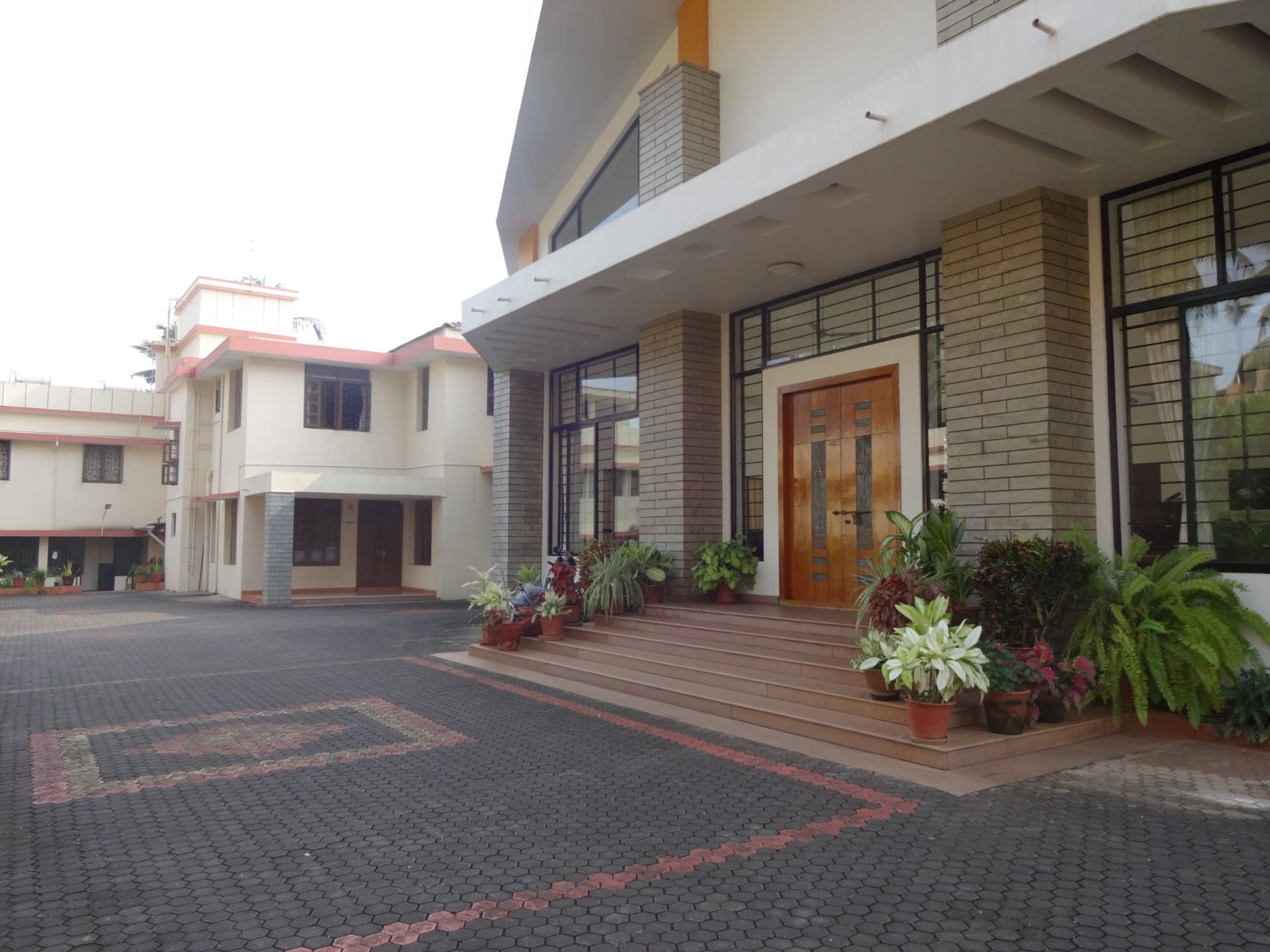
A final face-lift that HRC received was in 2009–2010. A new chapel in the same area but enlarged on all four sides was blessed by Rev. Fr Bonaventure Nazareth, parish priest, Valencia on December 13, 2009. This spacious and architecturally eye- catching edifice was the brain child of Rev. Sr Doreen D’Souza the Superior General. That was possible due to the hard earned money of the Ursuline Franciscan Sisters of European Region. Its surrounding having been furnished with interlocks, gives it a sense of veneration. A new Grotto has been constructed at the entrance of the HRC; our Mother of Holy Rosary beckons passers- by to go to Jesus through her. The parlour and Chapter Hall has been remodelled into a parlour and on the top two self-contained rooms for guests. Adjacent to it a class room for the use of pre- novices has been put up. The Grotto and this new block were inaugurated on April 8, 2010 by Most Rev. Dr Aloysius P D’Souza, Bishop of Mangalore.
The compound of HRC measuring almost three acres consisting of coconut and fruit trees and flower garden has been well maintained; several Sisters and formees have toiled in it and still are rendering joyful service to maintain eco-friendly environment. Over the years HRC has been available to the varied needs of the diocese such as catechizing the children of the neigbouring parishes and St Antony’s House; service to the retired and sick clergy of Mangalore Diocese at Vianny Home, Kankanady; tutoring the students of Dubois Commerce School, Kulshekar; service at Shanthi Kiran, Bajjodi; assistance in St Joseph Agricultural School Vamanjoor; service to the retreatants at Fatima Retreat House, Jeppu; assistance in CODP, Bishop’s House; secretarial assistance at Bishop’s House; Youth animation in ICYM; being on staff of DBCLC (Mangala Jyothi); service at Prakashalaya, St Joseph’s Seminary, Jeppu. Sisters’ involvement in the Social work at Veera Nagar, Jalligudda and Bajal-Padil for a number of years under the guidance of Rev. Fr Valerian D’Souza S J is still remembered by the people especially Muslims of this place.
Ever since its humble beginning in 1940, and official beginning in 1947, the HRC has been functioning as a house of administration, formation house, study house, house of hospitality, home for the sick, and much more service to the young girls and women through hostel and tailoring classes and nursery classes for children. Other than these inward-oriented compassionate deeds, the HRC has been rendering yeoman service in the parish – earlier at St Joseph parish Jeppu, Vincent Ferrer parish, Valencia and Fatima Retreat House. Now it renders service almost exclusively at Vincent Ferrer, Valencia. Catechizing, preparation for liturgical services, choir during sacred liturgy, decoration of the Church, distribution of communion, participating in SCC prayers, instructing parishioners on theological issues, addressing members of the Marian Sodality etc have been regular pastoral activities of the house. Let us wish that the HRC continues to reflect the face of Christ to Sisters within and people outside, the needy in particular.
